
Over the past week and a half, I stepped away from work for something very special: a visit from family traveling from the Netherlands, including our first grandson, now eight months old.
We are lucky. Even with an ocean between us, we stay closely connected.
We FaceTime every week. We wake up to new photos on our digital frame. WhatsApp delivers the tiny videos that make the distance feel a little smaller — a new sound, a funny expression, a wobbly attempt at something new.
And yet, nothing compared to being together in person.
Holding him. Watching him react to familiar voices in the room. Sharing meals, walks, laughter, and the ordinary little moments that suddenly felt anything but ordinary.
Technology helps us stay connected. But being together helped us feel connected.
And that distinction matters.
It made me think about independent schools and the families trying to understand them from a distance.
Your website matters. Your emails matter. Your social media, videos, digital ads, inquiry forms, nurture campaigns, and virtual information sessions all play an important role. They help families learn, compare, remember, and take the next step.
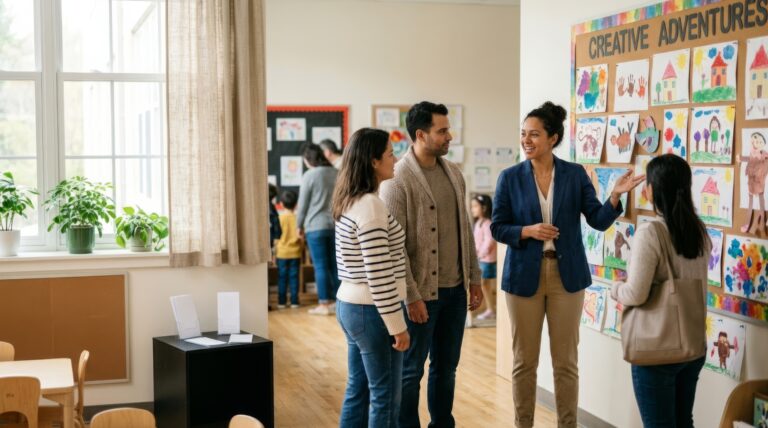
But there is still something powerful — and irreplaceable — about creating opportunities for families to step into your community and feel what makes it different.
Because families do not choose a school based on information alone.
They choose based on trust. They choose based on belonging. They choose when they can begin to imagine their child known, supported, challenged, and happy in your care.
And that is very hard to accomplish through a screen alone.
Digital can inform. In-person can convince.
In a digital-first world, it is easy to pour a lot of energy into the touchpoints we can schedule, automate, track, and optimize.
And we should.
A thoughtful digital strategy can reduce friction, answer questions, build confidence, and keep families engaged over time. A strong website can clarify your value proposition. A well-timed email can move a family from curiosity to action. A great video can bring your story to life.
But the in-person experience does something different. It gives families emotional proof.
They see how students greet one another in the hallway. They notice whether the front desk feels warm or transactional. They hear the unscripted comment from a teacher. They watch their child relax on the playground or light up in a science lab. They feel the energy of a campus, not just the claims made about it.
That is why in-person opportunities should not be treated as isolated events on the admissions calendar.
They should be part of a larger Connection Calendar — a deliberate sequence of moments designed to help families move from awareness to confidence and from confidence to belonging.
The Connection Calendar
A Connection Calendar looks beyond “What events are we hosting?” and asks a more important question: Where do families need to feel more connected in order to take the next step?
That might include:
- Early-season events that help prospective families move from passive interest to active consideration, such as open houses, information evenings, coffees with division heads, or small-group tours.
- Inquiry-to-application moments that deepen engagement, such as student shadow days, parent panels, classroom visits, or personalized follow-up conversations.
- Accepted-family experiences that support yield, such as newly enrolled family receptions, cocktails for parents, student buddy events, or welcome mornings.
- Summer connection points that prevent the quiet uncertainty that can creep in between enrollment and the first day of school, such as playground meetups, popsicles on campus, grade-level gatherings, or new-family coffees.
- Retention and transition moments that reassure current families at key decision points, such as rising-grade previews, parent education nights, classroom showcases, and division transition events.
- Alumni and community gatherings that remind people they are part of something bigger, such as homecoming games, reunions, alumni panels, and community celebrations.
The goal is not to create more events simply to fill the calendar. The goal is to create the right moments, at the right time, for the right audience — with a clear purpose behind each one.
Five Moments Families Need to Feel
So, as you head into ‘calendar planning season’ at your school, it’s a good time not just to take a look across your admissions and enrollment calendar, but also to consider whether your in-person experiences will be creating these five essential feelings.
1. Welcomed
Families should feel expected, not processed.
That starts before they arrive. Clear directions, thoughtful parking instructions, a warm confirmation email, and a friendly greeting all send a message: We are ready for you.
The first few minutes matter more than we sometimes realize. They shape whether a family feels like a guest, a number, or a future member of the community.
2. Seen
The most powerful admissions experiences are personal.
A child being greeted by name. A tour guide remembering an interest. A teacher asking a thoughtful question. An admissions team member acknowledging a parent’s concern without rushing to answer it.
Families want to know whether your school will understand their child.
Show them.
3. Connected
Belonging is not built through a presentation alone.
It often happens in the informal spaces: a conversation with another parent, a student ambassador’s honest reflection, a moment of laughter during a campus tour, or a casual interaction that feels genuine rather than staged.
Build in time for connection, not just content.
4. Confident
In-person events should reduce uncertainty.
Families should leave with a clearer sense of your program, your people, your expectations, and your next steps. They should understand not only what makes your school special, but why it matters for their child.
A beautiful event that leaves families unsure what to do next is a missed opportunity.
5. Excited
At some point, families need to picture their future with you.
They need to imagine the first day of school, the friendships, the traditions, the growth, the milestones, and the community they are joining.
The best in-person experiences create that emotional shift from “This seems like a good school” to “I can see us here.”
That is where enrollment momentum begins.
A checklist for your next in-person event
Before your next open house, information night, accepted-family reception, summer gathering, or alumni event, ask:
- What stage of the family journey does this event support?
- What do we want families to feel when they arrive?
- What do we want them to understand when they leave?
- Where can we create moments of genuine human connection?
- Who needs to be in the room beyond admissions or marketing?
- How will we follow up while the feeling is still fresh?
- What is the next step, and have we made it easy to take?
Because in-person events are not just calendar items. They are trust-building moments. They are storytelling opportunities. They are proof points.
And in a world where so much of the school search happens online, they may be more powerful than ever.
Digital connection matters. It keeps the conversation going. But face-to-face connection? That is what helps families believe.
The Hat Trick: 3 Key Takeaways
Digital keeps the conversation going. In-person makes it real.
Your website, emails, and social channels can build awareness, but campus experiences build belief.
The best events are not just scheduled — they are sequenced.
Open houses, accepted-family gatherings, summer meetups, transition events, and alumni moments should work together as part of a larger enrollment journey.
Belonging needs proof.
Families need to feel your culture, not just read about it.
Need help mapping the moments that matter most in your admissions and enrollment calendar?
Let’s build a connection strategy that turns interest into belonging.